Electric Fireplace Cost: How Much Should I Budget for an Electric Fireplace?

An electric fireplace is a plug-in or hard-wired appliance that uses LED lighting or atomized water to create a realistic flame effect and can provide supplemental electric resistance heat. In 2025, Electric fireplace cost for models in the U.S. typically ranges from $1,500 to $8,000 for the appliance alone, with premium water-vapor or built-in units starting around $2,500. Once installation, framing, electrical work, and finishing are factored in, recessed or feature-wall projects often total $4,000 to $12,000.
According to Mordor Intelligence (2025), the global electric fireplace market is valued at approximately $2.53 billion in 2025 and is projected to reach $3.19 billion by 2030, growing at a CAGR of around 4.75%. It is an evidence of steady adoption where venting limits or project timelines favor electric solutions. Data from Global Market Insights (2024) further shows that “the plug-in electric fireplaces segment dominated the market in 2024 by capturing a market share of 60.63%,” highlighting strong consumer demand for easy-to-install solutions.
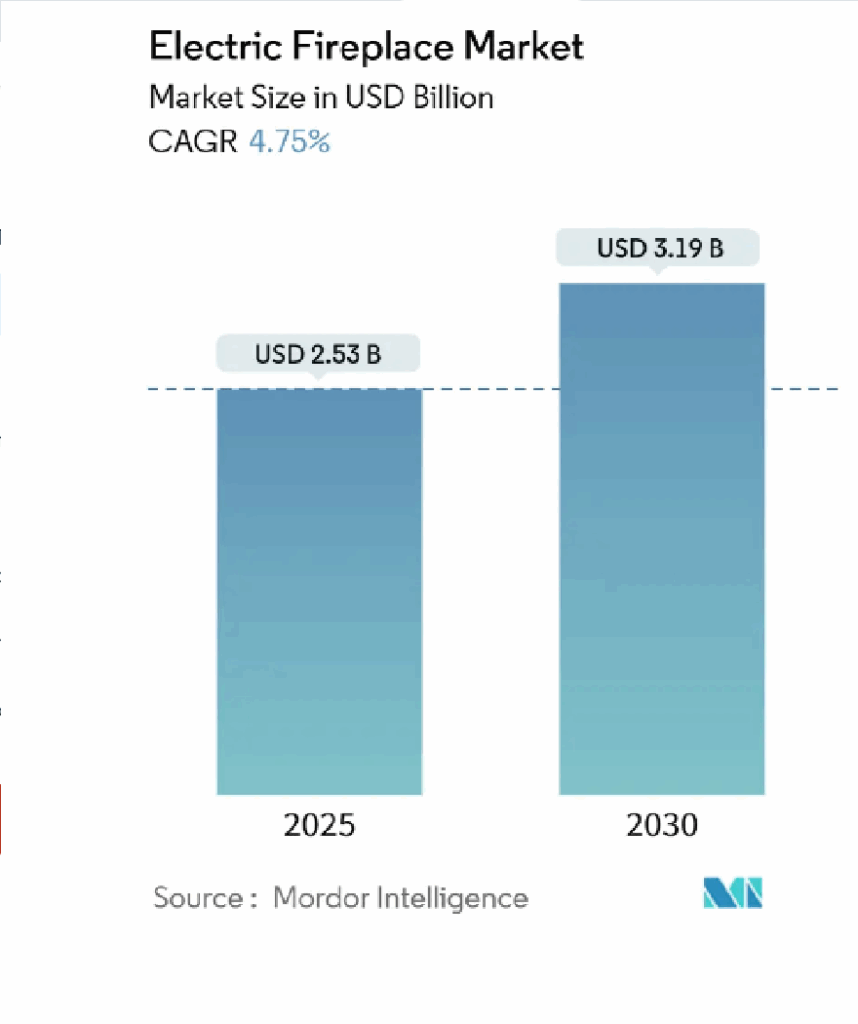
Source: https://www.mordorintelligence.com/industry-reports/global-electric-fireplace-market
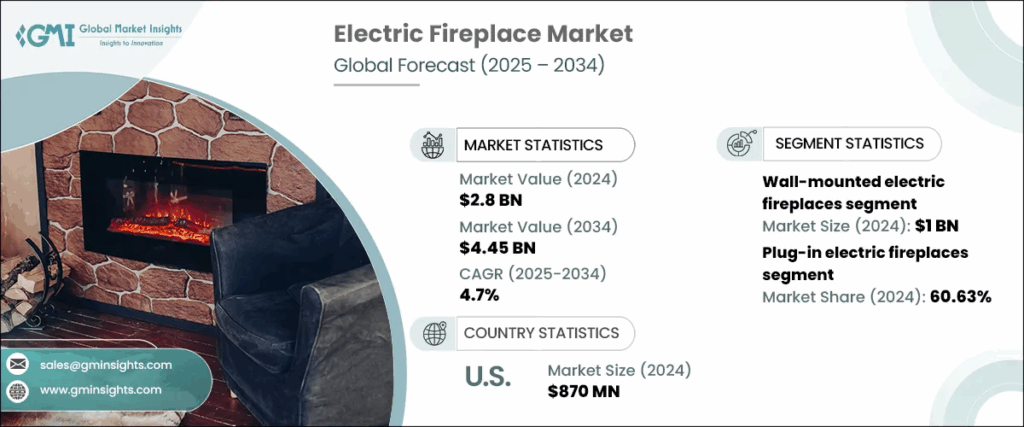
Source: https://www.gminsights.com/industry-analysis/electric-fireplace-market
What Is the Difference Between an Electric Fireplace and a Water Vapour Electric Fireplace?
A water vapour electric fireplace is a type of electric fireplace that uses a fine mist of water, illuminated by LED lights, to create an exceptionally realistic three-dimensional flame and smoke effect, while a standard electric fireplace produces its flame visuals through other methods such as LED projections, spinning light reflectors, or video displays. Both are powered entirely by electricity, involve no combustion, and can be installed without a chimney or vent, making them safe, low-maintenance, and suitable for use in almost any interior.
The main difference lies in purpose and performance. Water vapour electric fireplaces are primarily designed for visual authenticity and ambience, using ultrasonic technology to produce a flame effect that moves and flickers much like a real fire, but without generating significant heat. They are ideal for year-round use and for settings where creating a luxurious, lifelike focal point is the priority. Standard electric fireplaces, while often less visually deep or dynamic, typically incorporate built-in heaters capable of delivering supplemental warmth, making them a more practical option for spaces where heating functionality is important.
In short, a water vapour electric fireplace focuses on replicating the look of a real fire with maximum realism, whereas a standard electric fireplace balances decorative appeal with the ability to provide heat. The choice depends on whether the main goal is atmosphere and flame realism or a combination of visual effect and heating performance.
How Much Does an Electric Fireplace Cost?
An electric fireplace in the U.S. can range from about $1000 for basic plug-in models to well over $10,000 for large, custom-built installations, with most quality units falling between $1,500 and $8,000. The cost depends on several factors, starting with the type of fireplace. Freestanding and wall-mounted models are typically the most budget-friendly, as they can often be placed without structural changes and require only minimal labor. Inserts designed for existing openings sit in the middle of the range, offering a more integrated look without the full expense of new construction.
At the higher end are recessed or built-in fireplaces, which are designed to sit flush with the wall or form the centerpiece of a feature wall. These projects often require framing, drywall work, a dedicated electrical circuit, and high-end finishes such as stone, tile, or custom cabinetry. The technology inside the fireplace also influences price. Units with advanced flame effects, multi-color lighting, or water-vapor technology tend to cost more than basic LED models. Size, materials, and overall design ambition further shape the budget. A compact wall-hung model in a secondary room may be a straightforward purchase, while a wide-format, floor-to-ceiling installation in a main living space or commercial setting can become a significant design investment. Ultimately, the final price reflects not only the appliance itself but also the level of customization and the quality of the surrounding finishes.
How Much Does a Water Vapour Electric Fireplace Cost?
A water-vapor electric fireplace in the U.S. generally costs around $2,000 to $6,500 for the appliance and $4,500 to $12,000 installed when recessed or built into a feature wall with framing, electrical work, and custom finishes. The lower end typically covers smaller cassette models, while the upper end applies to large-format units integrated into premium designs. These figures align with retail pricing for quality water-vapor fireplaces and national installation data, which show that labor and materials can often double the appliance cost.
For a concrete benchmark from Planika, Cool Flame cassette inserts range from $2,335 for the smallest 500 model to $7,020 for the largest 2000. The Cool Flame Pro versions with a continuous water connection are $2,565 to $7,890. Framed single-sided models are $2,855–$3,545 (Pro: $3,085–$4,195), see-through models are $3,200–$4,010 (Pro: $3,430–$4,655), and freestanding options range $3,145–$4,530.
Tanked models run up to 12 hours per fill with power use from 220 W to 880 W depending on size, while Pro models offer unlimited operation at the same consumption. Accessories such as glass shields and log sets, priced $140–$640, add safety and design flexibility. In most projects, a freestanding setup will stay close to the appliance price, while recessed feature walls with custom finishes often bring the total into the $8,000–$12,000 range.
How Much Does an Indoor Electric Fireplace Cost?
An indoor electric fireplace in the U.S. typically runs $1,500 to $8,000 for the unit, and complete recessed or feature-wall installations usually land around $5,000 to $12,000 installed once framing, electrical work, drywall, and finishes are included. National cost trackers still show broad projects topping out near $10,000 installed, while premium water-vapor and large linear models list from the low-$2,000s to the mid-$4,000s for cassette inserts and up to about $8,000 for long built-ins, which is why real-world totals often push past the five-figure mark when you add site work and finishes.
Final price depends on type and scope. Wall-mounted or freestanding pieces tend to stay on the lower end because they require little labor, inserts that reuse an existing opening sit in the middle once you add a basic hookup, and fully recessed or custom feature walls move to the upper band due to framing, a dedicated circuit, and premium cladding or millwork. If you want a quick budgeting rule of thumb, start with the appliance class you need, check a current retail benchmark for that class, then add a realistic allowance for electrical and finishes based on how integrated you want the surround to look
How Much Does an Electric Fireplace Insert Cost?
An electric fireplace insert in the U.S. typically costs about $800 to $3,000 for the unit and roughly $1,800 to $6,000 installed, while premium inserts with advanced flame effects can list around $3,000 to $5,500 before installation. Prices vary by insert type (log sets vs firebox), size, and the finish work required to recess and trim the opening; real-world install totals often reflect both the appliance and labor for electrical and fit-out. National cost trackers show lower “typical” bands for simpler projects, while current retail listings confirm that top-tier inserts reach into the mid-$5,000s even before site work.
How Much Does it Cost to Run an Electric Fireplace?
It typically costs from $15 to $45 per month to run an electric fireplace if you use the built-in heater for 2–4 hours a day, and from $1 to $6 per month in flame-only mode at typical U.S. electricity rates. Most heaters draw 750–1,500 watts. On a common 1,500-watt setting, 2 hours a day for 30 days uses about 90 kWh; at usual residential rates that’s roughly $15–$25 per month. Four hours a day doubles that to about $30–$45. If your unit has a 750-watt “low” setting, expect roughly half those numbers. Flame visuals alone are inexpensive because many LED engines draw only a few dozen watts, so even daily use stays in the low single-digit dollars. Your exact bill depends on three things: your local ¢/kWh rate, how many hours per day you run it, and whether the thermostat cycles the heater off once the room reaches set temperature. For a quick estimate, use this formula with your own rate: cost = (watts ÷ 1000) × hours per day × 30 × $/kWh.
For a seasonal view, light daily heater use during a five-month heating season typically adds about $75–$180 to electricity costs, while flame-only ambiance remains just a few dollars for the same period.
How Much Does it Cost to Run an Electric Fireplace per Hour?
About $0.26 per hour with the 1,500-watt heater on, ~$0.13 per hour on a 750-watt setting, and ~$0.01–$0.05 per hour in flame-only mode at the current U.S. average residential electricity price. That math uses 17.47¢/kWh (May 2025 national average from the EIA) and typical electric-fireplace draws: about 1,500 W with heat and under 300 W for flame effects. To estimate for your home, use: cost per hour = (watts ÷ 1,000) × your local $/kWh.
How Much Does It Cost to Run a Water Vapour Electric Fireplace?
A water-vapor electric fireplace typically costs about $1.50 to $5.50 per month to run in flame-effect mode if used for 2–4 hours a day, based on the U.S. average residential electricity rate of 17.5¢/kWh in 2025. That’s because these units consume far less power than traditional electric fireplaces with heaters, generally between 220 W and 880 W depending on size.
For example, Planika’s Cool Flame cassette inserts draw 220 W (500), 440 W (1000), 660 W (1500), or 880 W (2000) when operating. At 17.5¢/kWh, running a 500 model for 3 hours a day for a month costs about $3.50, while a 2000 model under the same schedule costs about $14. Even at the largest size, annual operating costs for decorative flame effects remain well under $200 for typical daily use.
Because water-vapor fireplaces are designed for visual effect only (no heat output), running cost is almost entirely tied to powering the LED lighting and ultrasonic mist generator, making them a highly energy-efficient way to achieve a realistic flame look year-round.
How Much Does It Cost to Run a Water Vapour Electric Fireplace per Hour?
It costs roughly $0.04–$0.15 per hour to run a water-vapor electric fireplace at the U.S. average residential electricity price, depending on the cassette size. That range comes from typical power draws of ~220 W, 440 W, 660 W, and 880 W for common water-vapor models and the latest EIA-reported national residential rate of about 17¢/kWh (May 2025).
Converting watts to dollars: cost/hour = (watts ÷ 1000) × your local $/kWh. Using the EIA average, the per-hour costs are approximately $0.04 (220 W), $0.08 (440 W), $0.12 (660 W), and $0.15 (880 W). If your utility rate is higher or lower than the national average, scale the numbers using the same formula.
Where to find an Electric fireplace cost calculator?
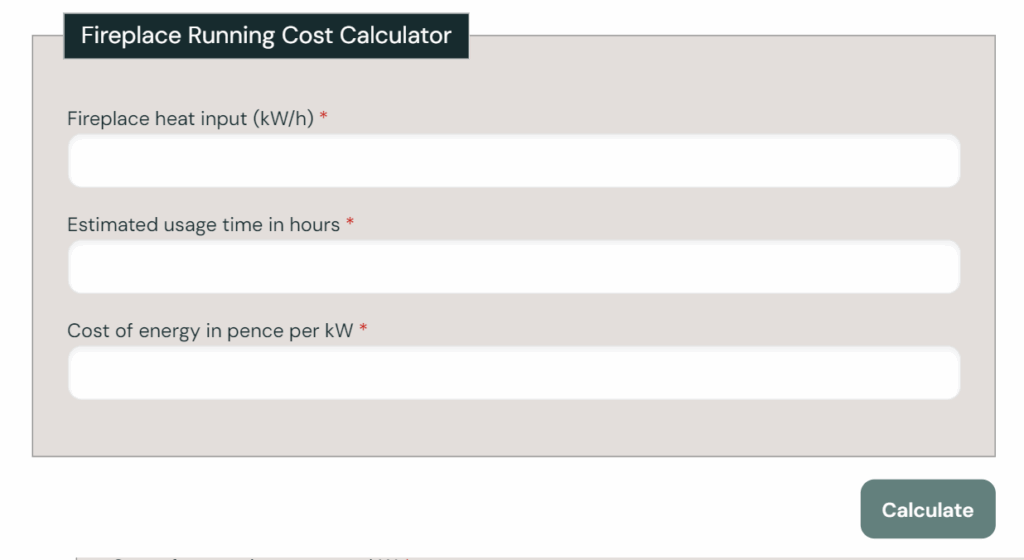
The fastest options are Napoleon’s Electric Cost Calculator, Direct Fireplaces’ Running Cost Calculator, GridHacker’s Electric Fireplace Electricity Usage Calculator, and Chimney Works’ Fireplace Usage Cost Calculator; if you prefer DIY, Energy.gov gives a simple formula you can plug your wattage and local rate into.
Napoleon’s tool is built specifically for electric fireplaces and lets you enter your electricity price, wattage, and typical usage to see hourly, daily, and monthly costs in one place. Direct Fireplaces’ calculator works for both gas and electric; for electric you’ll input heat input/output (in kW), hours of use, and your energy price to get a clear running-cost estimate. GridHacker’s calculator has a dedicated page for electric fireplaces and can show costs by hour, day, week, and month once you supply wattage and your $/kWh. Chimney Works’ calculator is a simple alternative if you just want a quick estimate without extra features.
How Much Does it Cost to Install an Electric fireplace?
Professional installation for an electric fireplace typically runs about $1,000 on average in the U.S., with published ranges from roughly $200 for simple placements to $10,000+ for fully integrated builds. Simple wall-mounted or plug-in installs usually land in the low hundreds to low thousands because there’s little construction involved, while recessed or built-in installations commonly cost from $1,500 to $3,000 before finishes due to electrical, framing, and drywall work. Projects that turn the unit into a feature wall with custom cladding and millwork can reach from $5,000 to more than $10,000.
Specific line items often drive the spread. Adding a standard outlet averages about $138–$320, running a dedicated 15–20A circuit averages about $700 with most jobs $570–$1,000, and drywall repairs commonly cost about $50–$75 per square foot or a few hundred dollars for small patches. When these tasks are needed, totals move quickly from the low thousands into the mid- to high-thousands.
How Much Does it Cost to Replace an Electric Fireplace?
Replacing an electric fireplace typically costs about $1,500–$6,000 all-in in the U.S., assuming you’re removing the old unit and professionally installing a new one; straightforward like-for-like swaps land near the low end, while upgrades to a recessed or feature-wall build commonly reach $5,000–$10,000+ once wall work and finishes are included.
What drives the total is the mix of removal, installation, and making good the surround. Removing an existing insert typically costs from $500 to $2,500 depending on size and access, after which professional installation averages ~$1,000 but ranges $200–$2,200 based on unit type and scope. If you’re recessing the new unit, expect $1,500–$3,000+ for the built-in work before it finishes.
Add-ons can nudge the price up: a new outlet averages $138–$320, a dedicated 15–20A circuit averages $570–$1,000, and drywall repair typically falls either $200–$750 for small interior wall fixes or $60–$80/sq ft for larger patches. These items explain why simple plug-in replacements can stay under ~$2,000, while recessed replacements with finish carpentry climb into the mid-to-high thousands.
What is the best place to buy an electric fireplace?
One of the best ways to buy an electric fireplace is through an authorized retailer or specialty dealer that works directly with manufacturers. This ensures you receive a genuine product, full warranty coverage, and access to professional installation services familiar with the specific models. Specialty fireplace showrooms and reputable online retailers also offer the advantage of knowledgeable staff who can guide you on sizing, technology options, and integration into your space.
For premium water-vapor and design-led electric fireplaces, Planika stands out in the market for combining high-end aesthetics with advanced flame technology. Products are available exclusively through approved dealers and project partners, which helps maintain quality standards and ensures customers benefit from tailored advice, technical support, and after-sales service. Whether you are designing a residential feature wall or specifying for a commercial space, purchasing through this network means the unit will be installed to the highest standard, with access to the brand’s full range of accessories and customization options.
Explore fireplace pricing and find your match at Planika
When planning your next project, understanding electric fireplace cost and the range of electric fireplaces prices on the market is essential for making the right decision. Electric fireplaces can vary from compact wall-mounted units for smaller spaces to advanced built-in designs with premium finishes that become the focal point of a room.
Planika’s water-vapor electric fireplaces are grouped into distinctive collections, each designed to meet specific project needs. The Cool Flame line features cassette inserts that use ultrafine water mist and LED lighting to create a realistic, three-dimensional flame effect without heat or emissions. It is perfect for spaces where ambiance is the priority. The Cool Flame Pro models connect directly to a water supply, enabling uninterrupted operation for high-traffic environments such as hotels, restaurants, and commercial lobbies. For clients seeking a complete solution, the Cool Flame Fireplace range offers framed single-sided and see-through enclosures for a ready-to-install statement piece. The AI freestanding collection delivers the same flame realism in a portable, elegant form, ideal for flexible layouts or spaces where built-in installation is not possible. The Aura freestanding model combines contemporary styling with integrated decorative logs for a warm, natural look.
With options ranging from sleek built-in designs to flexible freestanding models, Planika’s fireplaces blend high-end aesthetics with advanced flame technology, giving you a centerpiece that works as beautifully as it looks. Explore the full range, choose the right collection for your space, and bring your vision to life with Planika.