Gas vs Wood Fireplace vs BEV Ethanol: Key Differences & Comparison
A gas fireplace is a heating appliance that burns natural gas or propane within a sealed combustion chamber to produce flames and radiant warmth. These units often feature ceramic “logs,” adjustable flame controls and blower fans, and they vent through a dedicated flue or direct-vent pipe, offering clean, on-demand heat without ash, smoke or the need to store firewood. A wood-burning fireplace is the traditional masonry or prefab unit that combusts seasoned firewood in an open hearth or enclosed firebox. It delivers the classic crackle, aroma and visual warmth of a real wood fire but requires regular chimney cleaning, ash removal and adequate ventilation to manage smoke and creosote buildup. An ethanol (bio-ethanol) fireplace burns renewable alcohol fuel in a vent-free burner, producing real flames without soot, ash or a chimney. These freestanding or wall-mounted units install virtually anywhere and clean up easily, though they generate less heat per hour than gas or wood systems and rely on the ongoing purchase of liquid bio-fuel.
Typical installation costs vary considerably by system type. A new gas fireplace, including gas-line hookup, venting materials and finished surround, runs on average from $2,300 to $10,000 in the United States. Installing a wood-burning fireplace, whether a prefabricated insert or full masonry build with chimney work, averages between $7,000 and $14,000.
According to the U.S. Energy Information Administration’s Winter Fuels Outlook published in October 2024, natural gas is the primary space-heating fuel in 45 percent of U.S. households (eia.gov).
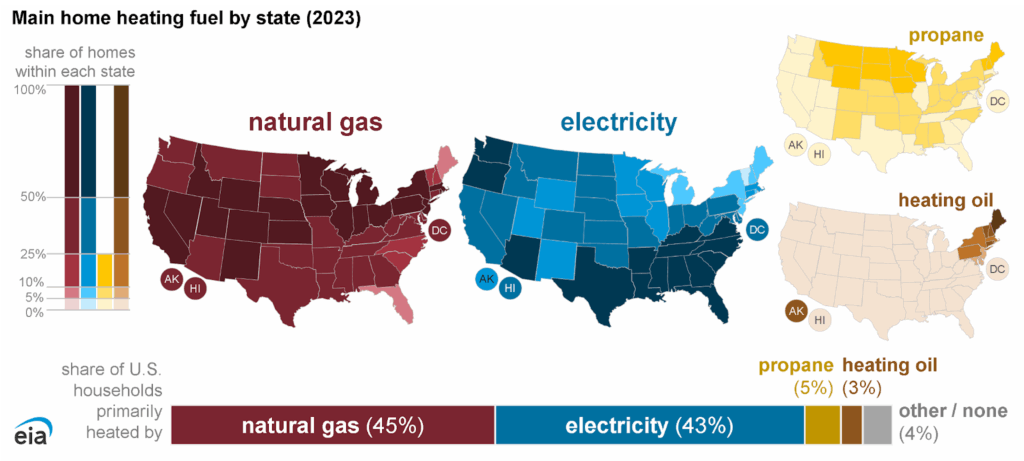
Source:https://www.eia.gov/pressroom/presentations/2024-10-10%20New%20York%20Energy%20Forum%20Presentation.pdf
“Households that use natural gas for heating, cooking and clothes drying save an average of $1,132 per year compared to homes using electricity for those applications,” reports the American Gas Association, highlighting both cost savings and the broad appeal of gas appliances (playbook.aga.org). At the same time, the floor-mounted central bioethanol fireplace market was valued at USD 1.2 billion in 2024 and is projected to grow to USD 2.8 billion by 2033, an 8.8 percent CAGR that underscores rapidly rising consumer demand for clean-burning, vent-free ethanol solutions (DataHorizzon Research).
Which is better, a gas or wood-burning fireplace?
For most homeowners seeking convenience and low maintenance, a gas fireplace is the better choice, while those craving authentic ambience and higher radiant heat output often prefer a wood-burning fireplace. Gas units deliver instant ignition, precise flame control and virtually no ash or soot, yet they depend on a reliable gas line and proper venting. Wood-burning fireplaces offer the sensory experience of crackling logs, rich aromas and strong radiant warmth but require on-site wood storage, regular ash removal and routine chimney cleanings.
In the sections that follow you will find clear definitions and real-world examples of gas, wood-burning and BEV ethanol fireplaces; a balanced analysis of their respective advantages and drawbacks; a comparison of heat output; insights into resale value; and a detailed cost breakdown covering installation and ongoing fuel expenses.
What Is a Gas Fireplace?
A gas fireplace is a heating appliance that burns natural gas or propane to produce flames and radiant warmth without the need for wood. Fuel enters the unit through a dedicated gas line, passes through control valves and a burner assembly, and is ignited either by a standing pilot light or an electronic ignition system. Heat is then radiated directly into the room or distributed via an optional blower fan.
There are two principal types of gas fireplaces. Vented (or “direct-vent”) models draw combustion air from outside and exhaust all by-products through a sealed flue, ensuring virtually no heat loss up the chimney and zero indoor emissions. Vent-free (or “ventless”) units burn fuel more completely at lower temperatures, allowing heat to radiate freely into the living space; they require no chimney or flue but must be installed in accordance with strict building-code guidelines and room-size requirements to maintain safe indoor air quality.
What are the pros of Gas Fireplaces?
Gas fireplaces excel in everyday convenience, entirely removing the need to haul, season and stack firewood or wrestle with ash removal and soot cleanup. Their clean-burning design generates virtually no smoke, ash or creosote, which means even vent-free models can deliver real flames with minimal maintenance and no lingering odors. The ease of installation is another major perk: many direct-vent units simply tie into an existing gas line and vent horizontally through an exterior wall, avoiding the expense and disruption of constructing a full masonry chimney. Once in place, total control is literally at your fingertips. With remote-control operation, you can ignite the fire, adjust flame height and heat output, set programmable timers or even integrate the fireplace with your home thermostat or smart-home system for fully automated comfort.
What are the cons of Gas Fireplaces?
The most immediate drawback to consider is fuel cost: residential natural gas prices averaged $14.57 per thousand cubic feet as of March 2025, and volatile markets can drive bills higher during cold snaps. You can check natural gas rates by state on Choose Energy’s Data Center (chooseenergy.com) . Beyond ongoing expenses, there are design limitations. Direct-vent units require a straight flue run or special coaxial piping, and vent-free models must meet strict room-size and airtightness codes, which can restrict placement and décor options. You’re also dependent on utility infrastructure: a gas line must already exist (or be installed) and any service interruption or leak can render the fireplace unusable until repairs are made. Finally, although modern ceramic logs look realistic, many purists feel gas flames lack the crackle, aroma and visual complexity of real wood, resulting in a less authentic ambience.A wood fireplace is a heating appliance that burns seasoned firewood in an enclosed firebox or open hearth to produce radiant warmth, flickering flames and the characteristic crackle and aroma of a real wood fire. Fueling the fire requires properly dried hardwoods, and combustion air enters either from the living space or through dedicated vents.
What is a Wood Fireplace?
A wood fireplace is a heating appliance that burns seasoned firewood in an enclosed firebox or open hearth to produce radiant warmth, flickering flames and the characteristic crackle and aroma of a real wood fire. Fueling the fire requires properly dried hardwoods, and combustion air enters either from the living space or through dedicated vents.
Classic masonry fireplaces are built on-site from brick, stone or refractory block, with a large open hearth and chimney that exhausts smoke upward. Their massive thermal mass retains heat long after the fire dies down, but the open design allows much of the warmed air to escape up the flue. Factory-built fireplaces with wood-burning inserts consist of a steel- or cast-iron firebox and insulated chimney liner installed within an existing masonry opening. Inserts boost efficiency, often over 70 percent, by sealing combustion gases and directing more heat into the room via built-in blowers, while still providing the look and feel of a traditional wood fire.
What are the pros of Wood Fireplace?
Wood fireplaces excel at creating an authentic ambience, filling a room with the rich crackle of burning logs, the warm glow of flickering flames, and the unmistakable scent of wood smoke that many homeowners find deeply comforting. They offer a sense of natural connection, using renewable firewood rather than relying on utility grids or fossil fuels, and they can operate completely off-grid, providing dependable heat even during power outages or gas-line failures. Moreover, seasoned hardwoods often cost less per BTU than propane or electricity, giving wood-burning units the potential for lower ongoing fuel expenses in areas with affordable timber. Finally, the substantial masonry or steel-insert construction of many wood fireplaces adds thermal mass or built-in heat circulation, allowing them to retain and radiate warmth long after the embers have died down.
What are the cons of Wood Fireplace?
Wood-burning fireplaces create significant dirt and ash, with fine soot particles scattering around the hearth and settling on nearby floors and furniture after each fire. This not only means more frequent sweeping and vacuuming but also risks tracking soot throughout your home. They require ample, well-ventilated wood storage, since logs must be seasoned for six to twelve months in a dry space to burn efficiently and cleanly. Without proper storage, wet or green wood will smoke excessively and accelerate creosote buildup. Traditional open‐hearth designs suffer from lower thermal efficiency, often losing 70-90 percent of generated heat up the chimney; even EPA-certified inserts typically convert only 60-70 percent of a cord’s heat into usable warmth, leaving much of your fuel’s energy wasted . Continuous upkeep, creosote sweeping, ash disposal and hearth cleaning, adds time and expense, and the lingering odors and particulate “soot creep” can aggravate allergies or respiratory issues.
What is a BEV Ethanol Fireplace?
A BEV (Burning Ethanol Vapors) fireplace is a vent-free bio-ethanol burner that uses Planika’s patented BEV Technology® to convert liquid ethanol into a clean-burning vapor. In this process, ethanol is stored in a sealed tank and, on demand, drawn into a microprocessor-controlled vaporizer where it is heated into a combustible gas. That gas then ignites in an isolated combustion chamber, producing a real flame without any smoke, soot or ash .
Examples of BEV ethanol fireplaces include freestanding models such as the Pillar series, which can hang or stand alone in open spaces; built-in tunnel or island units like the Forma line, designed for seamless integration into walls or custom surrounds; and outdoor burners (Cabo, Porto) that deliver smokeless fire features on patios without flue construction . All share the same core attributes: they run on renewable, plant-derived ethanol; require no chimney or venting; and offer fully automated operation, including remote-control ignition, six-stage flame adjustment, automatic refill options and mobile-app connectivity, while emitting zero harmful combustion by-products.
What are the pros of BEV Ethanol Fireplace?
BEV ethanol fireplaces based on Planika’s patented BEV® Technology offer vent-free flexibility, allowing installation without a chimney, flue or venting and fitting seamlessly into media walls, yachts or outdoor spaces . Their smoke-free, soot-free and ash-free operation produces real flames without any cleanup or indoor emissions, making them ideal for passive-house projects and urban condos with strict air-quality regulations . Fuel is stored in a sealed tank and vaporized on demand by a microprocessor-controlled system, delivering fully automated ignition and flame control via remote or mobile app, while an automatic refueling feature maintains optimal fuel levels without manual intervention . Multiple built-in safety sensors monitor seismic activity, fuel levels, temperature and potential spills and will shut the unit down instantly if an issue is detected . The result is a genuine flickering flame combined with premium design freedom and up to fifty percent lower installation and maintenance costs compared to traditional gas or wood systems .
What are the cons of BEV Ethanol Fireplace?
Drawbacks include a higher upfront investment than basic gas-log inserts or wood-burning units, reflecting the cost of vaporization and safety-control systems. The ongoing fuel expense for bio-ethanol typically runs higher per hour of burn time than natural gas or seasoned firewood, especially at elevated flame settings. Heat output is more modest, making these fireplaces ideal for ambience or supplemental warmth rather than primary heating. Because the vaporizer and safety sensors rely on electricity, the unit is dependent on a power source and won’t operate during an outage without backup generation. Finally, despite dosing systems that minimize spills, users must still store and handle liquid fuel safely, following proper ventilation and spill-cleanup protocols.
Do gas fireplaces put out as much heat as wood?
Generally, gas fireplaces deliver more usable heat to your living space per hour than traditional wood-burning fireplaces. Gas units typically burn 20 000 to 60 000 BTU per hour of fuel input and, with 70 to 80 percent thermal efficiency, provide roughly 14 000 to 48 000 BTU/h of actual heat output; high-efficiency gas inserts can exceed 90 percent efficiency, yielding more than 18 000 to 54 000 BTU/h of heat delivered to the room. By comparison, an open-hearth wood fireplace may generate 20 000 to 40 000 BTU/h at the firebox but suffer 70 to 90 percent heat loss up the chimney, so only 2 000 to 12 000 BTU/h ever reaches the living space. Modern EPA-certified wood-burning inserts improve combustion and reduce flue loss, achieving 60 to 70 percent efficiency and delivering 12 000 to 28 000 BTU/h of usable warmth from the same wood load. Even so, a properly sized and vented gas fireplace will generally provide a more consistent and higher heat output, making it the better choice if maximum hourly warmth is the priority.
Is gas or wood fireplace better for resale?
Gas fireplaces generally edge out wood-burning models in resale value. According to FastExpert, homes with any fireplace sell for about 13 percent more than comparable properties without one , and buyers overwhelmingly cite ease of use, consistent heat and minimal upkeep as their top priorities. In the National Association of Home Builders’ “What Home Buyers Really Want” survey, 55 percent of respondents rated gas fireplaces as desirable versus 48 percent for wood-burning models . Maintaining or adding a gas fireplace can therefore enhance a home’s marketability and command higher offers, whereas wood-burning fireplaces, while offering rustic charm, tend to appeal to a narrower segment of buyers and may deter those unwilling to manage firewood storage and chimney maintenance.
What is the difference in cost of Gas vs wood fireplace?
In this section we break down the key cost differences between gas and wood-burning fireplaces across three categories: installation, annual maintenance and fuel expenses. It will help you decide which system offers the best value for your home and budget.
Cost of Installation
Gas fireplaces typically require an investment of $2,300 to $10,000 for a new direct-vent insert or a fully customized surround with gas-line hookup and vent termination through a wall or roof . Wood-burning fireplaces, whether a factory-built insert or a full masonry construction complete with chimney, range from approximately $7,000 to over $14,000 .
Cost of Annual Maintenance
Annual servicing for a gas unit, which covers burner cleaning, seal inspections and pilot-control checks, runs about $150 to $600 per visit, with full system inspections (including vent checks) every few years costing $75 to $200. Wood fireplaces require an annual Level 1 or Level 2 chimney sweep to remove creosote and inspect the flue, averaging $168 to $563 per service according to Thumbtack, with full-scope inspections around $450 per Bob Vila; you’ll also need routine ash removal and hearth cleaning .
Cost of Fuel
Natural gas is billed by the therm (100,000 BTU) at an average rate of $1.45 per therm, so a light heating season consuming 20 to 30 therms will cost about $29 to $43 . Firewood averages $300 per cord (128 ft³), and a typical household uses 2 to 4 cords annually, for a total fuel expense of $600 to $1,200 .
Choose Gas with Planika – the architect’s fireplace solution
In summary, gas fireplaces stand out for their instant ignition, precise temperature control and low-maintenance operation, while wood-burning units excel at delivering authentic crackle, rich aromas and off-grid reliability. BEV ethanol fireplaces introduce a third path, combining real flame ambiance with vent-free installation and zero smoke or ash, ideal for contemporary and historic spaces alike. Water-vapour and electric “Cool Flame” models from Planika further expand the palette, offering safe, flameless alternatives with realistic mist and LED effects. Outdoor collections, ranging from linear gas inserts to portable ethanol burners, bring fire features to patios, terraces and hospitality environments without intrusive construction.
The BEV® ethanol range, including FLA4 wall inserts and UFO freestanding units, automates flame height, refilling and safety monitoring while cutting installation and upkeep costs by half compared to traditional fireplaces. Water-vapour insert systems recreate lifelike flames and embers without combustion, and electric “Cool Flame” cassettes blend mist, sound and lighting for fully programmable installations. Outdoor offerings cover fire pits, tables, columns and fireboxes in both gas and ethanol formats, complete with custom claddings, glass shields and smart-home integration.
With its diverse collection of gas, BEV ethanol, water-vapour, electric and outdoor fireplaces, Planika empowers architects and designers to create unforgettable indoor and outdoor environments. Explore detailed specifications and inspirational galleries on Planika’s homepage, then request personalized project support complete with guidance, technical documents and layout advice, directly through the site to bring your vision to life.